



Creating a ‘Global Roadmap’ for Peaceful Coexistence on the Korean Peninsula: 22nd PUAC Americas Regional Conference
- Peace & Unification Magazine No. 223
- 09-01-2026
Creating a ‘Global Roadmap’ for Peaceful Coexistence on the Korean Peninsula:
22nd PUAC Americas Regional Conference
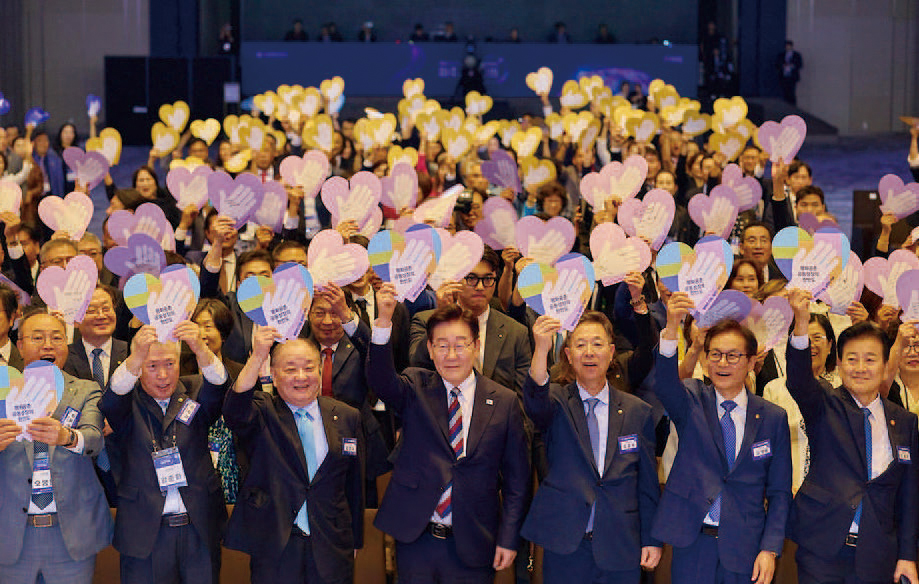
On September 2, President Lee Jae Myung and Americas Provincial Assembly members joined the “A Pledge for Peace, a Commitment to Action” ceremony, affirming their shared commitment to peaceful coexistence and shared prosperity on the Korean Peninsula.
Peaceful coexistence on the Korean Peninsula can be achieved more quickly when it gains broad understanding and support from the international community.
With this goal in mind, PUAC Council Members who have been actively engaged in grassroots citizen-led public diplomacy across the Americas gathered at INSPIRE Entertainment Resort in Incheon from September 1 to 4 for the 22nd PUAC Americas Regional Conference. A total of 1,122 Council Members from the Americas participated, with 724 attending in person and 398 joining online.
United by their determination to help usher in a new era on the Korean Peninsula, the Council Members pooled their collective wisdom to explore a concrete roadmap for citizen-led public diplomacy aimed at promoting peaceful coexistence.
Coming Home for Peaceful Coexistence on the Korean Peninsula
The 22nd PUAC Americas Regional Conference opened at INSPIRE Entertainment Resort in Incheon on Tuesday, September 1, under the theme “Global Solidarity for Peaceful Coexistence on the Korean Peninsula.” Throughout the day, Council Members from across the Americas arrived in Korea for the conference. Despite flights lasting at least ten hours, their faces showed both the joy of returning to their ancestral homeland after a long absence and their anticipation for the conference ahead.
After completing registration and checking into their accommodations, the Council Members launched into action in earnest that afternoon. Young Council Members took part in the Youth Committee Network Day, attending a special lecture by Professor Kim Young-jun of Korea National Defense University before moving on to small-group discussions and networking activities. Meanwhile, members of the Public Diplomacy Committee participated in a workshop where they shared peace and unification public diplomacy initiatives undertaken by their respective chapters and discussed future directions. They also held in-depth discussions on ways to promote participation in the “One Million Interviews on Peaceful Unification” initiative. A separate meeting for Council Members serving in leadership positions within the Americas Provincial Assembly and its municipal chapters also served as a forum for substantive discussion.
Following the afternoon program, Council Members attended an orientation for the main conference events beginning the following day, as well as a welcome dinner hosted by Executive Vice-chairperson Kang Chang-il. In a relaxed atmosphere, participants freely caught up with one another and exchanged views on peaceful coexistence on the Korean Peninsula. It was a symbolic prelude to the success of the conference.
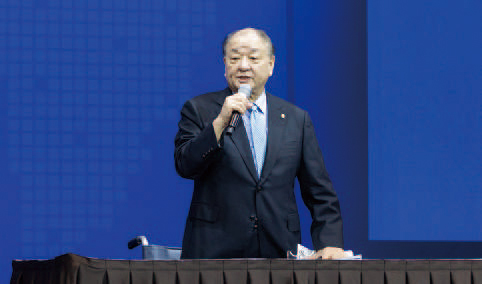
Executive Vice-chairperson Kang Chang-il emphasized the need to move forward together toward peaceful coexistence and shared prosperity between the two Koreas.
September 2, Sharing Milestones on the Path to Peaceful Coexistence on the Korean Peninsula
The 22nd PUAC Americas Regional Conference moved into full swing on September 2 with its opening ceremony. In his opening remarks, Lee Jae-soo, Vice-chairperson for the Americas Provincial Assembly, paid tribute to the participants’ dedication, saying, “Given the vast distances across the Americas, it is not easy for our Council Members to gather in one place. It is deeply moving to see all of you here in our homeland.” Lee continued, “Council Members across the Americas are actively engaged in grassroots citizen-led public diplomacy so that local communities can view the Korean Peninsula through the forward-looking values of peace and coexistence.” Then he added, “Through this Americas Regional Conference, we hope to bring together your wisdom and capabilities to advance peaceful coexistence on the Korean Peninsula and develop a concrete roadmap for the activities going forward,” declaring the conference open in a resounding voice.
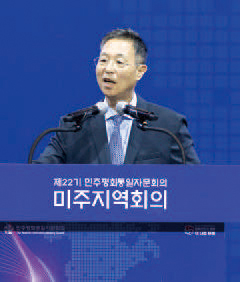
Lee Jae-soo, Vice-chairperson of the Americas Provincial Assembly, declared the 22nd PUAC Americas Regional Conference open and underscored the role of overseas Council Members.
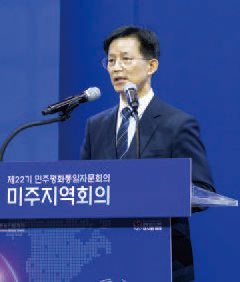
Secretary General Bang Yong-seung outlined the five key priorities of the 22nd PUAC and its work directions for 2026.
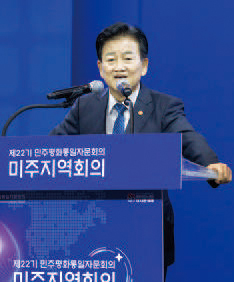
Minister of Unification Chung Dongyoung explained the government’s policy direction for peaceful coexistence on the Korean Peninsula and the role of PUAC Council Members across the Americas.
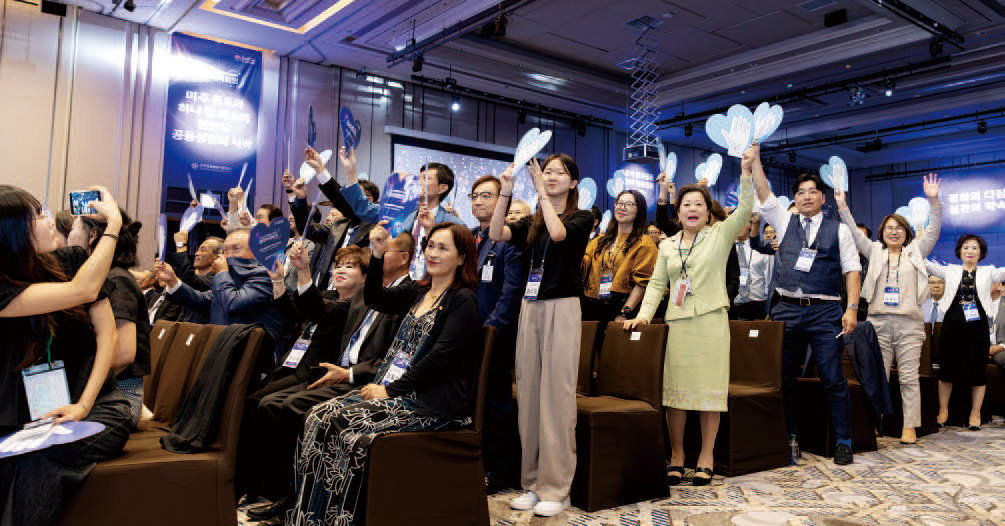
PUAC Council Members joined the “A Pledge for Peace, a Commitment to Action” ceremony, affirming their commitment to peaceful coexistence on the Korean Peninsula.
Executive Vice-chairperson Kang Chang-il delivered a keynote speech, in which he expressed his appreciation for the members’ citizen-led public diplomacy activities driven by love for their country. The Vice-chairperson recounted the great leap of South Korea, as the country overcame decades of low awareness and lack of information about Korea abroad and consolidated its standing as “Irreplaceable Korea,” to which he commented, “We are charged with a crucial mission to take a step further and bring forth the era of peaceful coexistence on the Korean Peninsula.” He stressed that, to fulfill the mission, the two Koreas need to sign an end-of-war agreement to bring peace to the Peninsula. Then the Vice-chairperson shouted, “Let’s work as one toward the peaceful coexistence and shared prosperity of the two Koreas,” to which the members responded with a resounding round of applause.
Taking to the podium after the Vice-chairperson, Secretary General Bang Yong-seung reported the 22nd PUAC’s efforts in 2026 focusing on its five priorities including the transition to debate/deliberation-based meetings, One Million Interviews on Peaceful Unification, social dialogue for peaceful unification, strengthening of education on peaceful coexistence, and reinforcement of PUAC’s activities. During the policy briefing that followed, Minister of Unification Chung Dongyoung explained the Lee Jae Myung government’s policies and added, “I ask the Americas Council Members to actively lend their support for the success of the Korean Peninsula Peaceful Coexistence Policy.”
The Peaceful Coexistence Policy Dialogue held that afternoon was joined by President and PUAC Chairperson Lee Jae Myung. After the opening remarks by Executive Vice-chairperson Kang Chang-il and a progress report by Secretary General Bang Yong-seung, President Lee Jae Myung watched a video showcasing the activities of the Americas Provincial Assembly members and listened to the policy proposals from three Council Members on “Global Solidarity for Peaceful Coexistence on the Korean Peninsula and the Practical Roles of Overseas Council Members.” Secretary Lee In-suk (Americas Provincial Assembly), Council Member Kim Woo-hyeon (Toronto Municipal Chapter), and Standing Member Seok Diana (Western South America Municipal Chapter) proposed diverse policies to achieve peaceful coexistence on the Korean Peninsula, under the respective themes of “Opening Up Peace on the Korean Peninsula Through Public Diplomacy Activities for Peaceful Unification,” “Knocking on the Doors of Inter-Korean Exchange with Overseas Koreans,” and “Strategies to Promote Awareness of Peace and Unification Among Future Generations of Overseas Koreans.” President Lee Jae Myung responded to each presentation with sincere applause.
“Thank you for making the long journey to join us here today.” Opening his speech with these warm words, the President said, “While South Korea is now closely interwoven with the world, the relationship between the South and the North remains completely severed when they should be the closest.” He added, “We cannot bring down the 80-year-old wall by waiting for it. We need to take action.” As milestones for these actions, President Lee proposed “Three Strategies for Peaceful Coexistence”: Inclusive Coexistence to bring down the divisions in our minds and take action; Stable Coexistence to remove sources of tension and ensure meaningful security; and Responsible Coexistence to contribute to world peace by achieving peace on the Korean Peninsula. He said, “We are the principal actors and main stakeholders in the matter of peace on the Korean Peninsula,” and added, “Let us work together so that our children can live happily in a peaceful, safe, and united nation.” After stepping down from the podium, President Lee Jae Myung was joined by PUAC Council Members for the “A Pledge for Peace, a Commitment to Action” ceremony, affirming their commitment to keep working for peaceful coexistence on the Korean Peninsula.
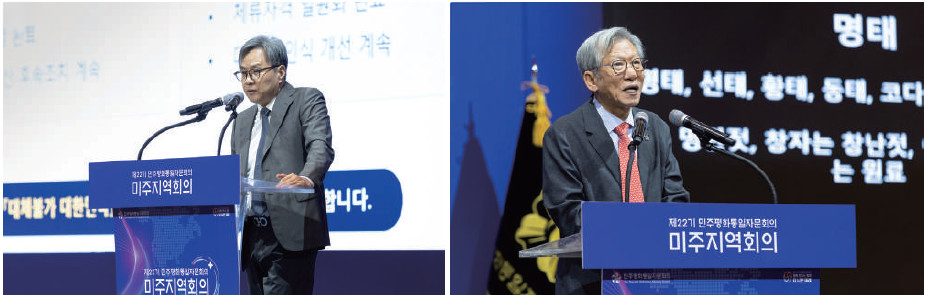
Vice Commissioner Kim Min-cheol of the Overseas Koreans Agency outlined the government’s overseas Korean policies and key issues, and shared his thoughts with the Americas Council Members.
Director You Hong June of the National Museum of Korea discussed the significance of Korean culture and history with the members.
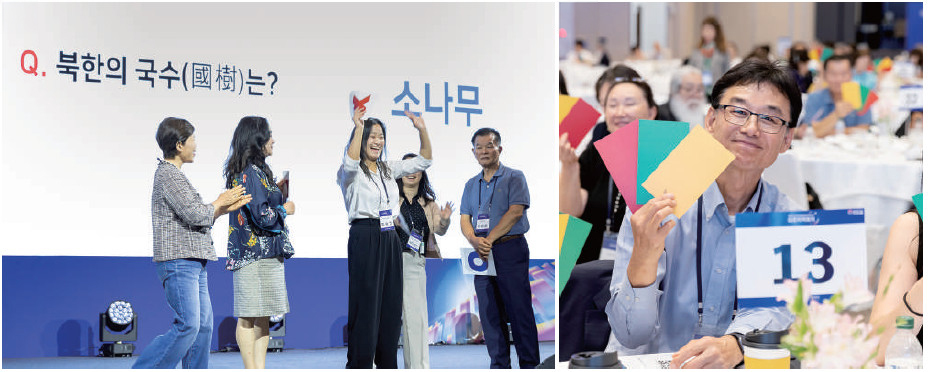
Council Members worked together to answer questions about peace during the “Peace OX Quiz” program.
Council Members are holding up color cards to express their opinions during a program.
September 3, Building the Capacity for Peaceful Coexistence Based on Respect for Difference
On the next day, September 3, Council Members held chapter meetings for two hours from 9:00 a.m. to discuss local issues, identify contact points between their respective regions and the Korean Peninsula Peaceful Coexistence Policy, and plan their future activities. After the meetings, Council Members gathered in the conference hall and, together with Vice Commissioner Kim Min-cheol of the Overseas Koreans Agency, closely reviewed the outcomes of the government’s overseas Korean policies in the first half of the year, along with the tasks for the latter half.
After lunch, members attended a special lecture by National Museum of Korea Director You Hong June, “Preview: North Korea’s Cultural Heritage.” Director You delivered an engaging lecture on North Korean food and cultural heritage sites in Mount Kumgang, Kaesong, Pyongyang, Wonsan, Hamhung, and Mount Paektu, interwoven with stories from his personal visits. Closing the lecture, the Director commented, “I hope the inter-Korean exchange resumes soon so that I can visit various heritage sites in North Korea with you,” to which the members responded with hopeful cheers.
The Council Members did not let even break times go to waste, actively networking with other members and participating in various programs including the “38 Jump Challenge” where they jumped the rope 38 times in an expression of their hope for the two Koreas becoming one across the 38th parallel. The break was followed by the highlight of the day, the roundtable discussions.
The roundtable discussions, under the theme “The Role of Overseas Council Members for Peaceful Coexistence on the Korean Peninsula,” were held in newly formed roundtable groups that mixed members from different regions and age groups to encourage a more diverse exchange of ideas. After introducing themselves, members at each roundtable shared their choice of words to complete the sentence, “To me, peace is ___,” using QR codes. Their choices of words were compiled into an infographic showcasing keywords such as comfort, happiness, hope, respect, communication, and love, providing a meaningful glimpse into their diverse ideas about peace. In the “Peace OX Quiz” that followed, each roundtable chose a representative to answer the questions. All Council Members participated in the quiz in an impressive show of concentration.
After loosening up their minds with the light-hearted quiz, the members took time to draw lessons from a multi-faceted review of the 255 policy proposals from Americas Provincial Assembly members. They then moved on to discussions on topics reflecting the results of the pre-conference survey of Council Members in the region. With “Action Plans for Peaceful Coexistence on the Korean Peninsula in the Americas” presented as the plenary discussion topic, the Council Members enthusiastically took part in the “Traffic Light Debate.” For each question, they held up the colored card that best represented their view and then shared their thoughts. Roundtable discussions on “Global Solidarity Strategies for Peaceful Coexistence on the Korean Peninsula” and “Finding the Role of Overseas PUAC Members as Citizen Diplomats” were equally lively. Participants also reviewed the results of real-time polls conducted for each discussion topic and explored future directions for their chapter activities. Throughout the process, they strengthened the very capacities essential to peaceful coexistence on the Korean Peninsula by listening to one another with respect and continually reminding themselves that differing views are not a matter of right and wrong.
To bring the roundtable discussions to a close with a “Time of Commitment,” Secretary General Bang Yong-seung and Americas Provincial Assembly Vice-chairperson Lee Jae-soo took the stage. They called for greater participation by the younger generation as future leaders in the era of peaceful coexistence on the Korean Peninsula, as well as efforts to nurture a new generation committed to peaceful coexistence, pledging their full support for these endeavors.
Building a Foundation to Expand Local Peaceful Coexistence Activities
On the following day, September 4, the municipal chapters carried out a wide range of activities of their own, including a DMZ Walk of Hope for Peaceful Unification, visits to sites of peace efforts, and exchanges with chapters in Korea. The 22nd PUAC Americas Regional Conference was a meaningful event that deepened participants’ understanding of the government’s Korean Peninsula Peaceful Coexistence Policy while strengthening global solidarity essential to bringing it to fruition. The conference will serve as a valuable foundation for activities for peaceful coexistence that Council Members across the Americas will carry out in their local communities.
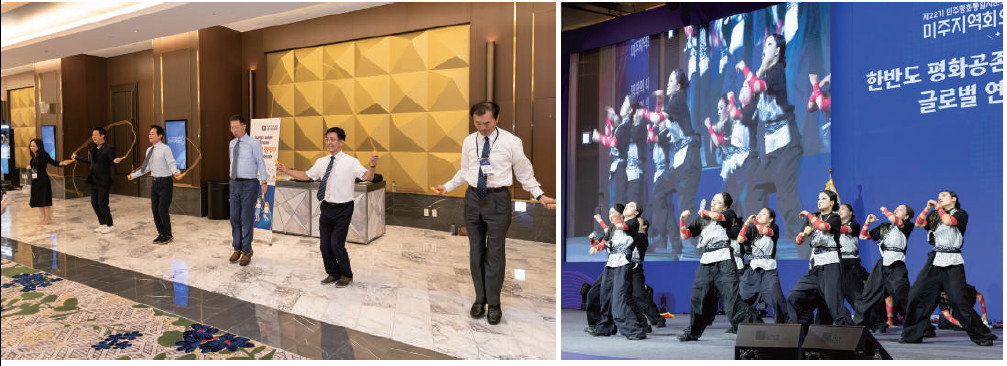
Council Members took on the “38 Jump Challenge” together, enjoying a light-hearted time of fellowship filled with laughter and energy.
A colorful range of performances added further meaning to the call for global solidarity for peaceful coexistence on the Korean Peninsula.
<Policy Proposals by Americas Provincial Assembly Members>
Opening Up Peace on the Korean Peninsula Through Public Diplomacy Activities for Peaceful Unification
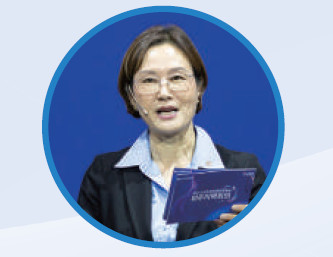
Council Member Lee In-suk, Secretary, Americas Provincial Assembly
Having carved out their own places in faraway lands, overseas Koreans in the Americas have undertaken various efforts to ensure that the voices of voters in Korean communities create the momentum to support peace on the Korean Peninsula.
Over the last year, Council Members across the Americas visited federal lawmakers in their respective regions to ask for support and cooperation in bringing peace to the Korean Peninsula, to which the lawmakers responded by promising full cooperation at the congressional level for peace and stability on the Peninsula. In May, before the U.S.-China summit, the Americas Provincial Assembly members partnered up with an NGO in the United States for the “Letter Mailing Campaign to the White House for Peace on the Korean Peninsula,” to demonstrate to the U.S. government the commitment of Korean communities in the Americas to the consolidation of peace on the Peninsula.. In addition, to promote understanding and support for peaceful coexistence on the Korean Peninsula, the Provincial Assembly organized programs for local citizens including “One Million Interviews on Peaceful Unification” and the “38 Jump Challenge.”
We ask for your continued attention and support so that these citizen diplomacy initiatives across various countries do not end as one-off events but continue on a sustained basis..
Knocking on the Doors of inter-Korean Exchange with Overseas Koreans
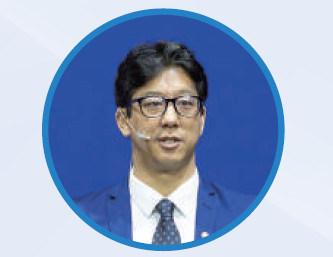
Council Member Kim Woo-hyeon, Toronto Municipal Chapter
While Canada is a close partner of Korea, it also maintains diplomatic relations with North Korea. This position allows the country to serve as a new conduit to improve inter-Korean relations. Guided by this understanding, overseas Koreans living in Canada have engaged in efforts to consolidate peace on the Korean Peninsula. We supported the foundation and operation of Pyongyang University of Science and Technology, including by sending professors to teach there. We also carried out cooperative projects bringing the two Koreas and other countries together.
Building on this experience, in February this year, the Toronto Municipal Chapter mediated a memorandum of understanding between York University in Toronto, which I attended, and the Pyongyang University of Science and Technology, to create opportunities for North Korean students to interact with young overseas Koreans. Meanwhile, the Vancouver Municipal Chapter planned a peace tour in the Wonsan Kalma Coastal Tourist Area to create opportunities for informal encounters between North Korean residents and Council Members and overseas Koreans with Canadian citizenship.
These efforts of the two chapters were eventually frustrated by both domestic and international circumstances. However, like the Chairperson said, “Knock, and it will be opened to you.” We will continue to address challenges and take action despite the difficulties. To move these efforts forward, I would like to propose two policies to promote exchange and cooperation between the two Koreas.
First, I would like to ask the government to establish policies for supporting and guiding inter-Korean exchange and cooperation efforts so that we can actively engage in the efforts based on our local human network and experience.
Second, if Korea capitalizes on its strong diplomatic clout to build a network for inter-Korean exchange and cooperation among countries with diplomatic ties to both Koreas, such as Canada, Vietnam, and Singapore, it will increase opportunities for peaceful coexistence on the Korean Peninsula.
Strategies to Promote Awareness of Peace and Unification Among Future Generations of Overseas Koreans
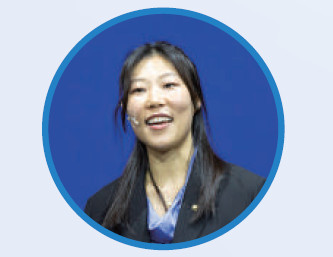
Standing Member Seok Diana, Western South America Municipal Chapter
In Argentina, there is a place called “Unification Park,” which the Western South America Municipal Chapter and local Koreans built 25 years ago as a place to represent our hope for peace on the Korean Peninsula.
On August 8, at the Unification Park, the chapter organized the Drawing Contest for Peace on the Korean Peninsula with junior PUAC member students. It was a meaningful event connecting the older generation’s longing embodied in the park with the hope of the future generation.
Our junior members are actively participating in programs across the Americas. Junior members in Los Angeles, United States, organized discussions on Korean Peninsula issues, while junior members in San Francisco shared their thoughts on peace with fellow junior members from Qingdao, China. The Western South America Municipal Chapter held a PUAC conference for junior members to boost their pride in their homeland and aspirations of peace.
During the Eurasia Regional Conference in July, the Chairperson said he hoped that young PUAC Council Members will serve as the focal point for the efforts to build a Junior PUAC. Before the Chairperson and fellow Council Members, I would like to suggest a plan to bring the proposal to fruition.
Fellow Council Members, I ask that you make active use of historic sites across the Americas, such as Unification Park, the Philip Jaisohn Memorial House, and sites associated with Dosan Ahn Chang-ho, that embody both the history of overseas Koreans and the aspiration for peace on the Korean Peninsula, so these places can serve as invaluable resources for educating future generations about peace.
Mr. Chairperson, I would also like to propose expanding opportunities for young overseas Koreans to visit their homeland. Many young Koreans abroad have a strong interest in Korean culture but few opportunities to visit Korea themselves. By giving them more opportunities to visit their homeland, deepen their understanding of Korea, take pride in their heritage, and nurture hopes for peace, I am confident that we can work together with future generations to help bring peace to the Korean Peninsula.
-
How satisfied are you with the information you have reviewed?