



22nd Americas Regional Conference: Chairperson’s Speech
- Peace & Unification Magazine No. 223
- 09-01-2026
22nd Americas Regional Conference: Chairperson’s Speech
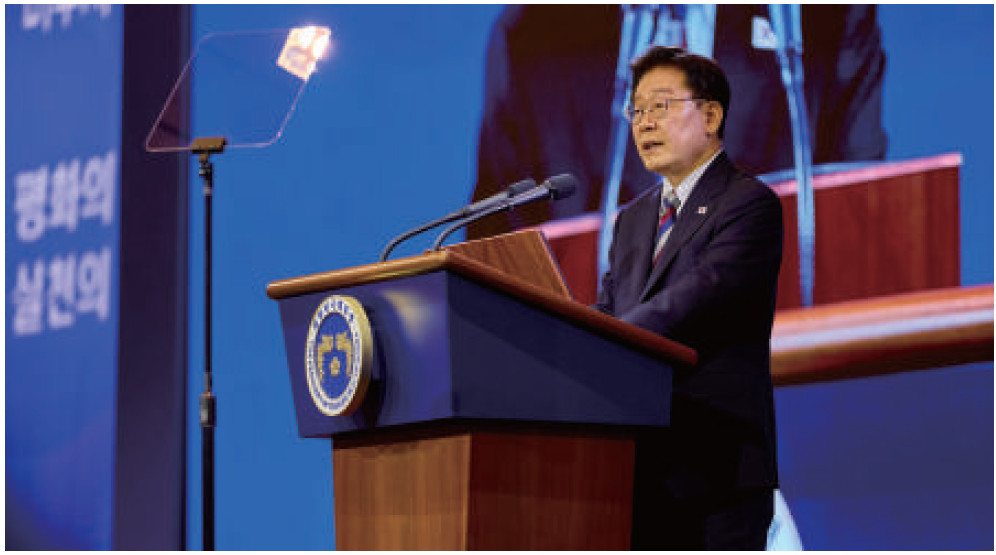
Members of the 22nd Americas Provincial Assembly,
I heard that it cost a fortune to come all the way here. I am sincerely grateful to you for taking the long journey here, and taking an interest in Korea’s unification and peace issues.
I noticed that some of you came from South America, which I visited a while ago. It was a long trip, to say the least. I will take your passion to heart.
Incheon holds a special place in Korea’s modern history, and the history of the Korean diaspora in the Americas.
Today, Incheon is a highly advanced international city serving as a gateway to Korea. More than a hundred years ago, when it was called Jemulpo, it was a port city where many tearful farewells were shared as our ancestors boarded ships to Hawaii and Mexico to make a living.
Your ancestors toiled under sunlight in henequen plantations. Despite the hardship, they set aside a part of their pay to support the independence movement. They built schools to teach their children Korean and, after working at the plantation during the day, trained officers for the independence army at night.
Even though their country did not protect them when they left, they did not abandon their homeland. The “Irreplaceable Korea” that we know today was built with the sweat and blood of our people in Korea and overseas.
Now I am reminded that their spirit is still alive today. I would like to thank our fellow Koreans overseas for their steadfast commitment and support for more than 100 years. Now, Korea will be there for you as your trustworthy guardian.
Now, Korea is tightly interwoven with the world.
Around 10,000 Korean companies are operating across the world, and 50 million people travel to and from Korea each year.
However, the relationship between the South and the North remains completely severed, when they should be the closest. We are wasting our strength in conflicts and confrontations, when we could use it to move forward. It is a truly unfortunate and harsh reality, one that we must change.
This wall has stood for more than 80 years. We cannot bring it down by waiting for it. We must take action. However, we should not be hasty, and we need to have a clear destination before we move.
As part of my speech on Liberation Day, I shared “Three Blueprints for Peaceful Coexistence on the Korean Peninsula”: Inclusive Coexistence to bring down the divisions in our minds and take action; Stable Coexistence to remove sources of tension and ensure meaningful security; and Responsible Coexistence to contribute to world peace by achieving peace on the Korean Peninsula.
Now that we have set the milestones, it is time to move forward. I trust that you, our Council Members, will develop concrete ways to put these ideas into action and take the lead in doing so. Inclusive coexistence must, of course, begin with mutual respect. Peace does not mean that everyone thinks alike. It begins with respecting our differences, with listening to views different from our own and learning how to live together. I am confident that the experience and role of Koreans in the Americas, who have lived alongside people of different ethnic and cultural backgrounds, will be of great value. For peaceful coexistence to be stable and responsible, peace itself must be firmly x-x-x-x-embedded in our institutions and structures. We must transform the armistice system, which is premised on confrontation and conflict, into a peace system that can serve as a foundation for cooperation and prosperity, so that tensions never escalate again driven by shifts in domestic politics or the ups and downs of the international environment.
Now that President Trump’s decision has opened at least some possibility for change in the situation on the Korean Peninsula, we must work to create the conditions for constructive discussions aimed at rebuilding trust and resuming dialogue between North Korea and the United States.
Peace on the Korean Peninsula does not concern us alone. It is key to stability in Northeast Asia and, more broadly, a core task for world peace. As a direct party to this important task, the Republic of Korea will fulfill its responsibility by regaining wartime operational control. I trust that our Council Members in the Americas will also take a special interest in this issue and lend their support. To that end, communication with experts, legislatures, and citizens in your countries of residence is crucial. I also ask for your active participation in the “One Million Global Citizen Interviews,” one of the key projects of the 22nd PUAC. If each of you conveys the value of peace from where you live and work, I am confident that people around the world will ultimately join us on the road to peace on the Korean Peninsula.
Fellow citizens, and members from the Americas Provincial Assembly,
We are the principal actors and main stakeholders in the matter of peace on the Korean Peninsula.
Our words carry weight when we make our own judgments and act on our own initiative. And the Republic of Korea has the strength to do just that. Don’t you agree?
We are the great Republic of Korea that transformed itself from a country receiving aid into one that provides aid, and achieved both democratization and industrialization faster than anywhere else in the world. Today, Korea has become a country that the world reaches out to first, the “Irreplaceable Korea.”
“Here and now, we are responsible for that destiny.”
I am told that this is a line from a novel about the history of Korean immigrants in Mexico, who put down roots in a new land despite harsh circumstances. The clock of inter-Korean dialogue has been stopped for seven years. The wall has grown higher, and no road is in sight. Even so, we must keep walking. If we take the first steps, the path we walk will itself become the road.
It is we, here and now, who must make that road. I believe that this is the responsibility and mission of our generation. There was no road laid out for those who left Jemulpo Port 123 years ago, either. They built a road where none existed, and walked on it themselves.
Dear Council Members, once again, we need your strength.
Just as earlier generations of Koreans overseas overcame hardship and supported the cause of independence, I trust that this time you will bring together your wisdom and take action to fulfill our aspiration for peace on the Korean Peninsula. May I count on you?
You have traveled halfway around the world and spent a considerable sum just to be here, and I do not know whether you have been satisfied with the conference so far. But Korea has now grown and come into its own to the point where, instead of being a country you must worry about, it can afford to worry about you and stand behind you. Is that not something to be proud of?
The division of the Korean Peninsula may feel as though it has lasted for ages, and it may seem to be fading from people’s attention. But when we step back and look through the broader lens of history, we have been separated for only a fleeting moment. Throughout world history, have we not seen countries come together again after hundreds of years or even more than a thousand years apart?
Through our efforts, and through yours, let us work together so that future generations can live happy and hopeful lives in a unified, peaceful, and secure country.
It is a pleasure to be here with you. And thank you.
-
How satisfied are you with the information you have reviewed?